Cat tree for large cats and Maine Coons: how to choose the right one
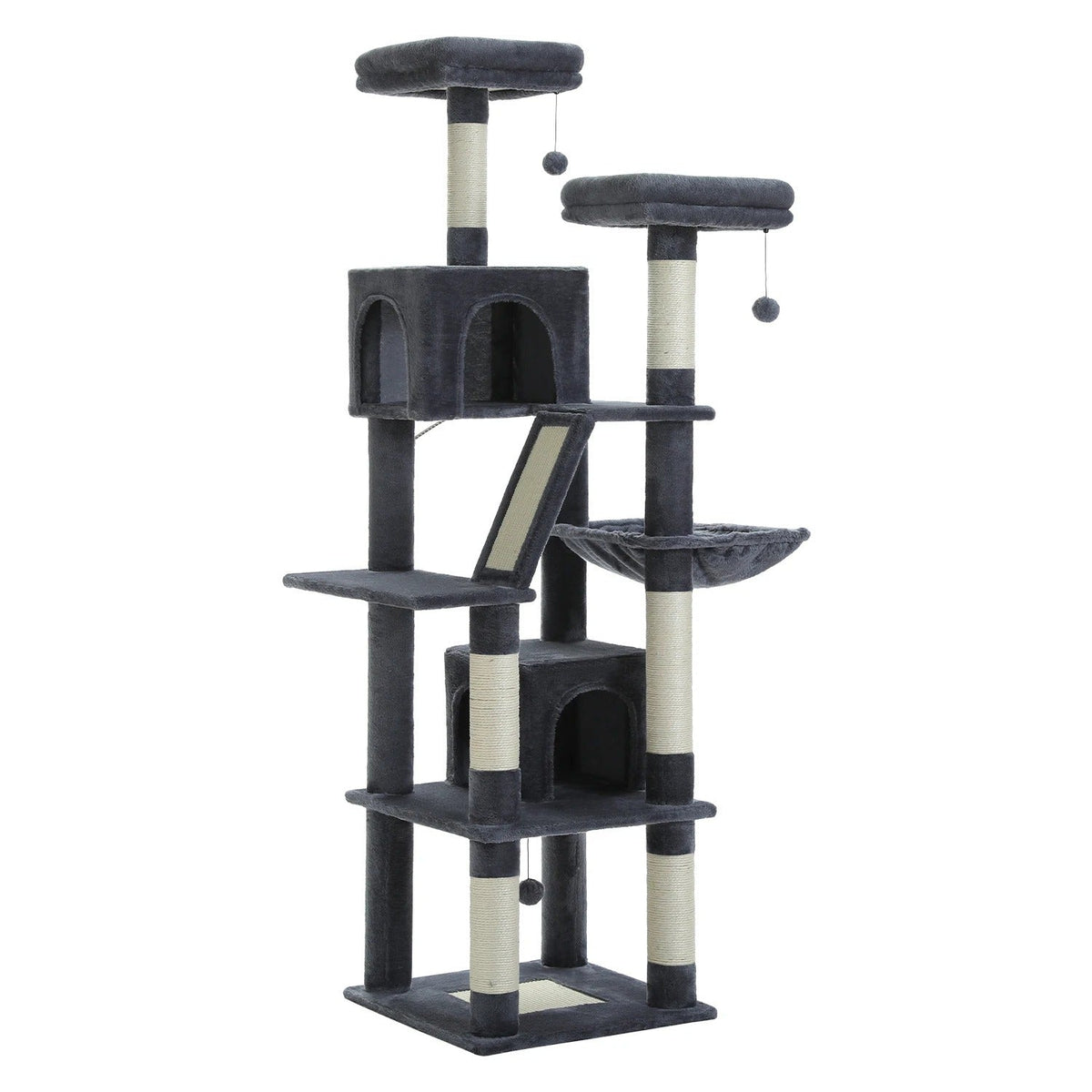
You may have been through this already: a cat tree that looked big in the photos, assembled on a Sunday afternoon… and a cat trying to settle on the platform, back legs hanging in mid-air, before giving up and going back to the sofa. The problem isn't your cat. Most cat trees are designed for a four-kilo cat. For a Maine Coon, a Ragdoll, a Norwegian Forest cat, or simply a multi-cat home, you need to look at other criteria.
Why your cat needs height
Climbing isn't a whim, it's a need. Up high, a cat watches over its territory, feels safe and sleeps more deeply. Without a place designed for it, it will find one on its own: the top of the bookcase, the fridge, the wardrobe. A good cat tree gives it that perch, a place to scratch and, in a multi-cat home, a way to share space without conflict.
5 criteria for a large cat
1. Beds it fits in completely
This is the most overlooked criterion. An adult Maine Coon can measure over a metre from nose to tail tip. On a 30 cm platform, it will never really lie down. Look for caves and platforms of at least 45 to 55 cm across: your cat should be able to stretch out fully, without curling into a knot.
2. A wide base and wall anchoring
A large cat jumping onto the top level puts a lot of force on the structure. If the tree wobbles, even slightly, it won't climb again. Choose a wide base and a fixing system: anti-tip strap, wall bracket or ceiling support. Always place the tree against a wall.
3. Thick sisal posts
Natural sisal is cats' favourite material for scratching. But a thin post bends when a large cat pulls on it with its full weight. Thick posts (8 to 9 cm in diameter) stay stable and last longer. The more posts there are, the less your sofa gets used as a scratcher.
4. The right height
For a large cat, aim for 1.80 m to 2 m: high enough to overlook the room, with levels about 40 to 45 cm apart, the distance a cat clears in a single leap. If floor space is tight, a floor-to-ceiling model gives you height without the footprint.
5. Several beds if you have several cats
Two cats don't willingly share one good perch. They need several beds at different heights: a low den for the shyest one, a high perch for the most confident, a hammock for the one that likes to be cradled. Each has its own refuge, and territorial disputes ease off.
Where to put the cat tree?
A cat tree tucked away in a room nobody uses often stays empty. Put it in a living area, where the family spends time, ideally near a window: your cat can watch the outside world from the top, and that's often what wins it over.
Which model for your situation?
- A Maine Coon or a very large cat: our 200 cm cat tree for Maine Coons offers 9 levels, two caves of 55 × 50 cm and 50 × 50 cm, two hammocks and ten natural sisal posts, on an 80 × 50 cm base. It suits cats up to 10 kg.
- Several cats: Colette, our 180 cm cat tree, has five beds at different heights: two round rimmed perches, two enclosed dens (one high, one low), a hammock, and a sisal ramp that doubles as a staircase for older cats. An anti-tip strap is included.
- Little floor space: the floor-to-ceiling cactus cat tree rises from 229 to 275 cm thanks to a telescopic pole, with five levels, a hammock at the very top and 9 cm sisal posts. It takes up the footprint of a potted plant.
As a complement: a dedicated scratching post
Even with a large tree, a scratching post near the sofa or the entrance is very effective at keeping claws off the furniture. For a large cat that loves to stretch out fully, the Marcel 80 cm standing scratching post is tall enough; if space is short, the Léon wall-mounted scratcher can be fixed at the height of your choice.
Assembly and care
Assemble the tree flat, from the bottom up, and allow one to one and a half hours with two people. For care, a quick vacuum of the plush and a brush of the sisal is all it takes: avoid washing with lots of water.
Frequently asked questions
My cat doesn't use its cat tree, what should I do?
First check the location (living area, near a window) and the stability. Then rub a blanket your cat loves on the beds, or leave a few treats on the lower levels. Most cats start with the bottom cave, then climb level by level over a few days.
Can a cat tree tip over?
A tall tree that isn't secured can sway when a large cat jumps on it. Place it against a wall and use the strap or wall bracket provided: that's the best guarantee of stability.
What height should I choose for a Maine Coon?
Between 1.80 m and 2 m, and above all with wide platforms and caves. Height matters, but bed size matters even more.
A good cat tree for a large cat is one it fits in completely, that doesn't move when it jumps, and that stands where the family lives. Tick those three boxes, and it will quickly become its favourite spot in the house.